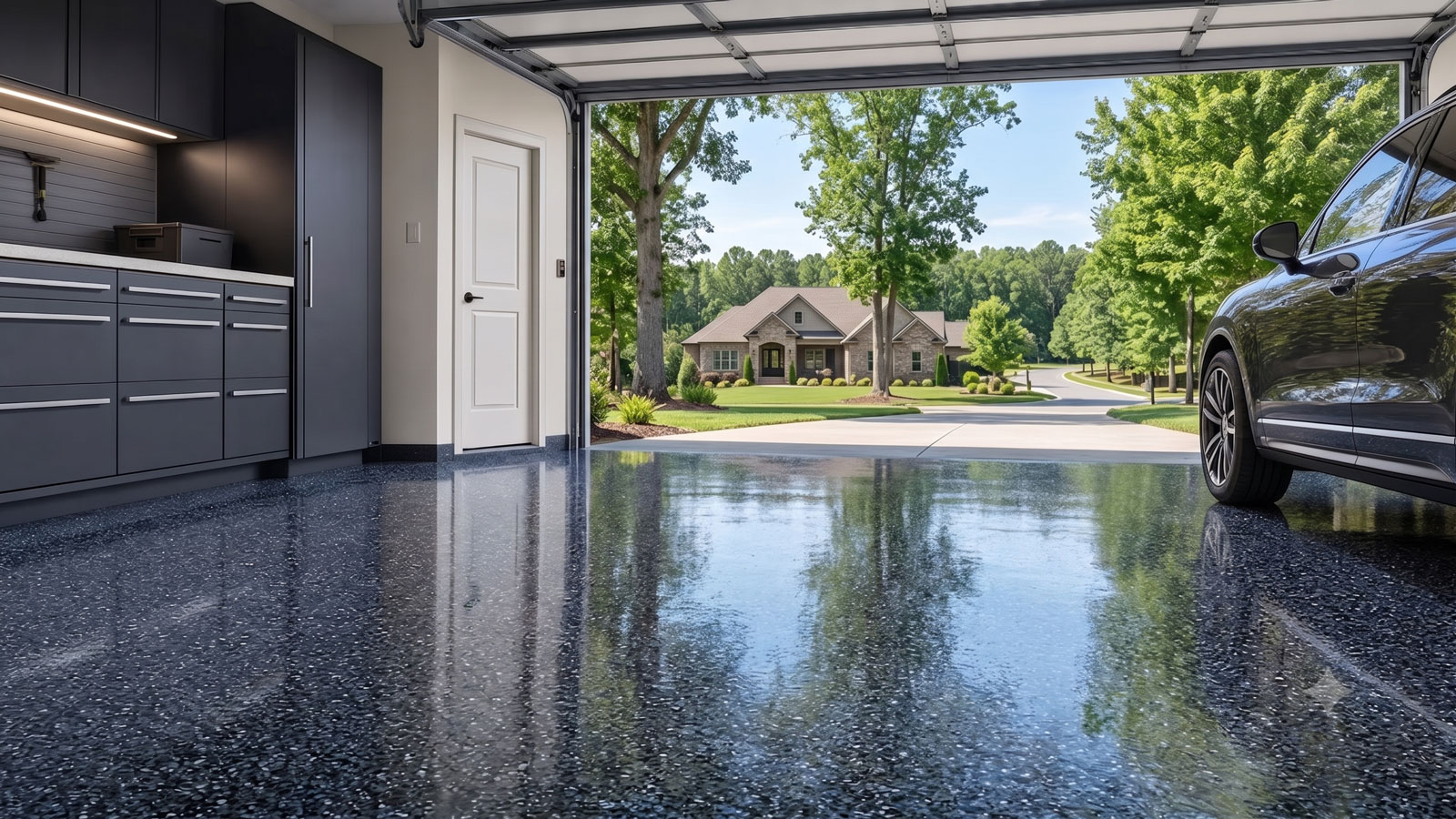
Garage Floor Coating in Midlothian, VA
Floor Coating Services in Midlothian, VA
Midlothian combines long-established neighborhoods with large waves of newer Chesterfield County development. That means two nearby garages can have very different slabs: one may have decades of vehicle stains and repairs, while another may be relatively young but still carry curing compounds, construction residue, or shrinkage cracks. House age alone is not enough to predict the floor, because later garage additions, repours and remodeling can create several concrete generations within the same established neighborhood.
The area also includes rolling terrain, wooded lots, neighborhood drainage systems, and driveways that can slope toward or away from the garage. When runoff reaches the door or dampness appears along slab edges, correcting the water path matters before covering the concrete. Newer subdivisions can also have runoff issues if downspouts, driveway pitch or grading concentrate water at the garage door, so recently built does not automatically mean drainage-free.
Many Midlothian garages do more than store cars. They function as the everyday family entrance, sports-equipment storage, workshop space, and staging area for lawn or outdoor gear. A good coating plan accounts for traction, cleanability, storage movement, and how quickly the garage needs to return to service.
Local Market Insight
Midlothian's biggest local distinction is the mix of older established subdivisions and newer Chesterfield growth. Slab age, construction history, driveway grade, and daily family use can change preparation needs even within the same neighborhood.
What Affects the Cost of Garage Floor Coating in Midlothian?
Midlothian's established neighborhoods and newer Chesterfield development create different preparation profiles. Older floors may have coatings, repairs, contamination or mixed pours, while younger slabs may need curing products, sealers and builder residue mechanically removed. Driveway grade, storage-heavy layouts, traction needs and return-to-service timing can further change scope.
- Older versus newer slabs: Established neighborhoods may require more crack repair or coating removal, while newer slabs may need careful profiling to remove curing residues or surface hardeners. The estimate should state exactly what removal or profiling is included before the new coating is applied.
- Driveway grade and runoff: A driveway that sends stormwater toward the door can create extra moisture concerns that should be addressed before coating. Check the actual property condition rather than assuming a neighborhood-wide moisture or drainage problem.
- Storage-heavy garages: Wall systems, shelving, freezers, and household storage can add moving and staging time. Mechanical preparation should reach sound concrete rather than simply roughen an incompatible surface layer.
- Crack and joint treatment: Control joints, shrinkage cracks, and repaired areas affect both preparation time and the final visual result. The repair plan should distinguish stable defects from joints or movement that may require different treatment.
- Traction and finish: Busy family entryways and wet-weather use may justify a more textured finish rather than a smoother decorative surface. Match texture and cleanability to how the garage is used, especially when wet shoes, tools or equipment are common.
- Previous repairs or coatings: Long-established Midlothian garages may have old patch compounds, paint, or DIY coatings that need removal before the new system is installed. Include perimeter, threshold, steps and other detail work in the scope rather than relying only on open-floor square footage.
Call for a clear, project-specific estimate — or request one online.
Local Garage-Floor Conditions in Midlothian
Start with the concrete rather than the coating catalog. Look for peeling paint, sealer, oil staining, patch compounds, cracks, and any damp areas. Mechanical preparation needs to expose a clean, sound surface instead of simply roughening whatever happens to be on top.
If the garage has a history of water at the door, drainage should be part of the conversation. A coating can make cleanup easier, but it is not a substitute for correcting exterior runoff or a persistent moisture source.
For active Midlothian households, scheduling matters too. Decide where vehicles and stored items will go and how quickly the space must return to use. Cure-time expectations can influence system choice.
Established Neighborhoods and Newer Subdivisions
Older Midlothian homes can have garages that have been repainted, patched, or used as workshops for years. Newer subdivisions often have cleaner-looking slabs, but appearance alone does not tell you whether curing compounds or construction contamination remain.
The right estimate should reflect what the floor actually needs. Two equally sized garages can have very different preparation costs when one is a straightforward young slab and the other has old coatings, cracks, or moisture history.
That established-versus-newer split also affects how quotes should be compared. A young slab with a dense finish may require extensive profiling despite looking clean, while an older floor may need paint removal, crack repair and edge work. The homeowner should be able to see which preparation tasks are actually driving labor rather than relying on age or square footage alone.
Midlothian's Long Development Timeline Matters
Midlothian has an unusually long development history for a Richmond suburb. The area was tied to the first commercial coal mining in America, the 1807 Midlothian Turnpike, and early rail transport, while Chesterfield County later experienced enormous suburban growth during the late twentieth century.
For a garage-floor project, the lesson is not that an old house automatically has an old slab. It is that Midlothian contains genuinely different generations of housing and accessory structures, so previous coatings, repairs, drainage, construction methods, and garage layouts should be inspected rather than assumed.
Midlothian's coal-mining and transportation history is useful because it shows just how long the area has been developed, while modern Chesterfield growth adds an entirely different suburban layer. The practical consequence is a wide range of garage forms and slab histories. Surface treatment, drainage and actual garage use should be inspected separately rather than inferred from the neighborhood name.
For Midlothian families, storage and daily-entry use can also affect sequencing. Cabinets, freezers, sports gear and vehicles may need to be moved in stages, and the return-to-service window should be planned before work begins rather than treated as an afterthought.
Midlothian Garage Floor Coating FAQs
Does a newer Midlothian garage need grinding?
Usually some form of mechanical surface preparation is still appropriate. New concrete can have curing residue, surface hardening, or a smooth finish that needs profiling for dependable adhesion.
What if rainwater comes under my garage door?
Identify and address the exterior water path first. Coating the slab may improve cleanability, but it will not stop water that is being directed into the garage.
Do control joints need to be filled?
Not always. Some systems leave joints visible and others treat selected joints. The decision depends on slab movement, appearance goals, and installer specifications.
Which finish works well for a garage used as the main family entrance?
A flake system with practical texture is popular because it hides small debris and provides useful traction. The exact texture should balance grip with ease of cleaning.
Does Midlothian's historic coal-mining past change what coating I should buy?
Not by itself. The useful takeaway is that the area contains very different development eras. Evaluate the actual garage slab, repairs, coatings, moisture, and layout instead of inferring condition from the neighborhood name.
Midlothian Neighborhoods & Local Context
Phone Quote Line
Speak with a floor coating specialist about your project and get a realistic estimate range.
(804) 424-4555Typical Project Cost
$3,000–$5,500
Typical range for a two-car garage. Final pricing depends on floor size, concrete condition, prep work, coating type, and finish options.
Helpful Guides
Other Service Areas